5 early warning signs of settlement risk developers can’t ignore
Settlement risk builds quietly. Here are 5 early signs developers and project marketers should watch for, and how to catch them in time.
Read more →

.png)
Settlement is where months of sales momentum either convert cleanly into completed transactions, or start to unravel. For developers and project marketers managing large pipelines, the risk rarely shows up as one dramatic failure. It builds quietly – from a buyer who stops responding, a finance approval running long, or a document that never quite arrives.
By the time these issues surface as a delayed or failed settlement, the warning signs were usually visible weeks earlier. Here are five warning signs of settlement risk worth watching closely, and what they tend to mean for a pipeline.
A buyer who was easy to reach during the sales process but has gone silent as settlement approaches is one of the clearest risk indicators there is. Silence can mean they’ve lost confidence, hit a financing problem they haven’t disclosed, or simply don’t understand what’s being asked of them next. Without a structured way to track engagement across a pipeline, this kind of disengagement is easy to miss until it’s a last-minute scramble.
Loan approval status is one of the most consequential unknowns in any settlement, and often the hardest to track. If a buyer’s finance position hasn’t been confirmed within a reasonable window of the settlement date, that’s not a detail to leave sitting in an inbox. Developers who can see finance readiness across every buyer in a project, rather than chasing status updates individually, catch these gaps while there’s still time to act.
Identification verification, updated contact details, solicitor instructions – settlement depends on a stack of documentation that has to be complete and correct. A single missing piece can hold up an entire transaction. When document status lives across email threads, spreadsheets, and someone’s memory, gaps go unnoticed until they become deadline problems.
If getting an accurate read on where every buyer sits – communication history, document status, finance confirmation, key dates – requires pulling from multiple systems and asking around the team, that’s a structural risk in itself. Settlement risk compounds when visibility is fragmented, because problems that would be obvious in a single view stay hidden until someone goes looking for them.
An increase in buyer queries in the final weeks before settlement is usually a symptom, not a cause. It tends to mean buyers haven’t had clear, consistent information along the way and are now trying to piece together what they need to do and by when. A well-informed buyer rarely needs to ask what’s happening next.
None of these signs are unusual on their own. What matters is whether a developer or project marketer can see them early enough to act. Settld is a property settlement management software built to give teams that visibility across the full settlement stage – from exchange through to handover. It brings buyer communication, document tracking, and milestone status into one place, so the risk signals above show up as they emerge.
For teams managing off-the-plan, retirement living, or build-to-residential projects, that visibility is what turns settlement from a reactive scramble into a stage the whole team can see coming.
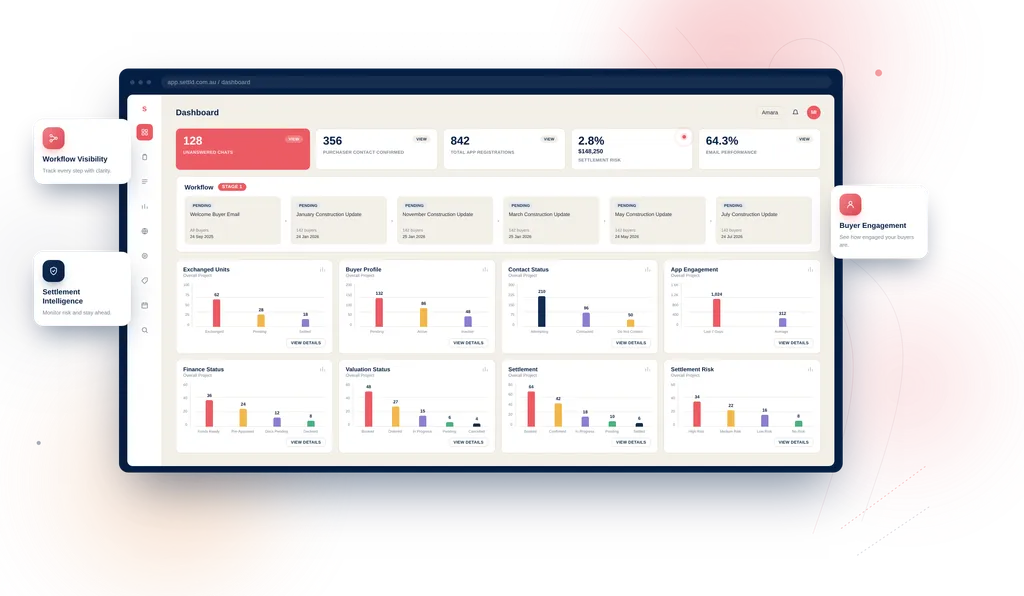
Settld brings buyer communication, documents, and milestones into one view, so early warning signs surface while there’s still time to act.
Book a demo to see how it works for your project.